The Delhi High Court (HC) on Sunday upheld the Union Government’s decision to shift climate activist Sonam Wangchuk to Safdarjung Hospital, noting that the move was justified in view of his deteriorating health, following an extended hunger strike. The court ruled that the government’s action was neither arbitrary nor unlawful, and junked allegations that Wangchuk was being detained illegally or that his bodily autonomy had been violated.
The HC passed the order while hearing a petition filed by Wangchuk’s wife, Gitanjali Angmo, who sought permission to transfer him from the government-run hospital to Medanta Hospital, contending that he should be allowed to receive treatment at a medical facility of his choice.
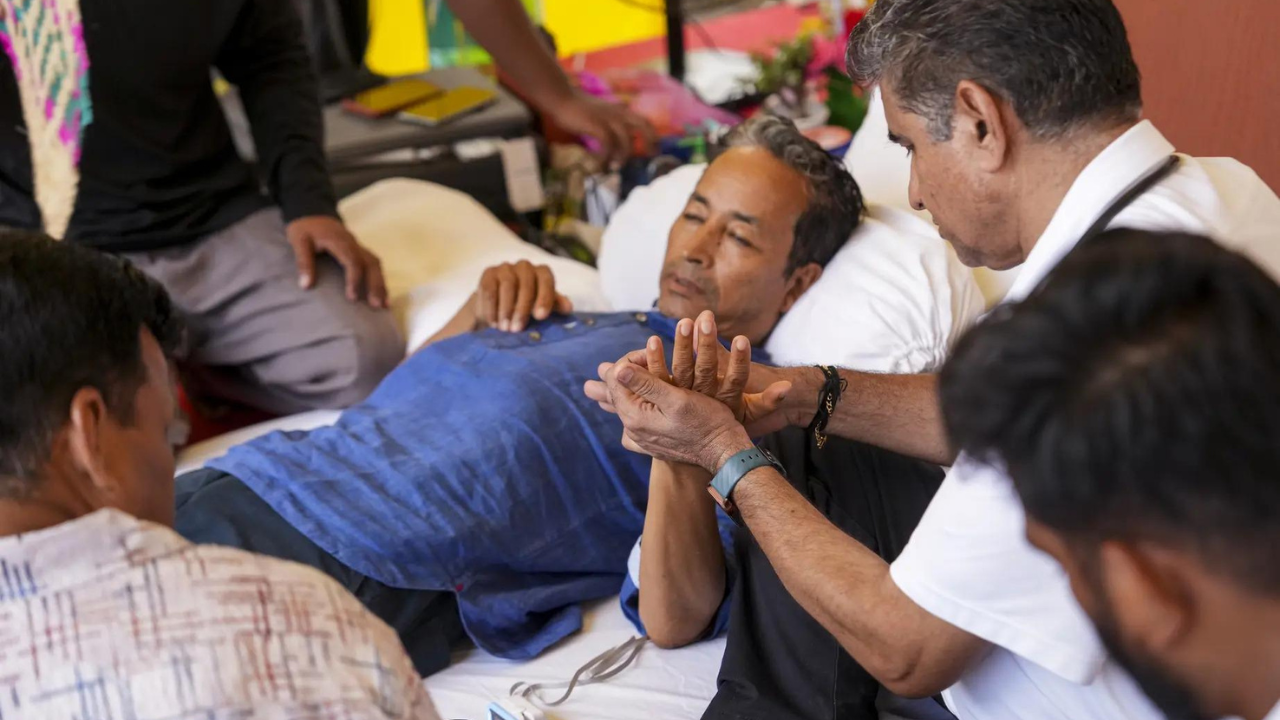 Wangchuk during hunger strike
The court thereafter issued notices to the Centre, Delhi Police and Safdarjug Hospital, directing them to file their responses within three days. The matter will now be heard on Thursday. However, the HC refused to grant any interim relief.
“Wangchuk had low blood sugar”: Govt tells HC
During the proceedings, the court noted that Wangchuk had been on a hunger strike for as many as 18 days and referred to an order issued earlier by a division bench of the Delhi HC on July 16, concerning his worsening medical condition.
The government informed the court that Wangchuk had been shifted to the hospital from the protest site at Jantar Mantar owing to serious health concerns, including low blood sugar and dangerously low potassium levels. Accepting the government’s submission, the court noted that the decision to hospitalise Wangchuk was taken solely on medical grounds.
The bench remarked, “Since the government has taken the decision to shift him to hospital on account of his medical condition, this court does not see the same to be arbitrary action.”

Furthermore, it also took note of the government’s submission that every life is precious and must be protected. The Additional Solicitor General argued that Wangchuk’s prolonged fasting, humid weather and dehydration had led to a rise in health risks, including the possibility of ketosis and other serious complications.
“Wangchuk not in detention,” says HC
Senior advocate Kapil Sibal, appearing on behalf of Wangchuk, contended that there was no detention order or criminal case against the activist and questioned whether the government could compel a citizen to remain in a government hospital. He further argued that Wangchuk should have the freedom to choose his doctors and preferred medical facility, suggesting that government doctors could continue monitoring his condition even if he was shifted to Medanta Hospital.
The HC, however, clarified repeatedly that Wangchuk remained a free citizen and was not under any form of detention. The bench held that Wangchuk had not voluntarily admitted himself to any medical institution and observed that considering his fragile health, the government was justified in transferring him to a hospital for medical supervision.
Court asks Wangchuk to cooperate with doctors
The government urged the court to order Wangchuk to cooperate with the doctors treating him. While the bench clarified that it was not compelling him to undergo any specific treatment, it observed that he should cooperate with the medical team if he chose to receive medical care.
 Delhi HC
It ruled towards the end that all decisions relating to Wangchuk’s treatment should be taken by the attending doctors strictly in accordance with the established medical protocols.