Madhya Pradesh took a major step towards expanding modern public transport on Thursday as Union Road Transport and Highways Minister Nitin Gadkari and state Chief Minister (CM) Dr Mohan Yadav jointly launched the Mukhyamantri Sugam Parivahan Seva and PM E-Bus Seva at BHEL Dussehra Maidan in Bhopal.
Under the state's Mobility Vision-2030, the two leaders flagged off 351 intercity and intracity buses for seven cities. The service, launched on the birth anniversary of Pandit Deendayal Upadhyaya, is aimed at strengthening urban-rural connectivity and providing citizens with safe, convenient, modern and environmentally friendly public transport.
The government has set a target of connecting 75 per cent of the state's gram panchayats with bus services as the network expands.
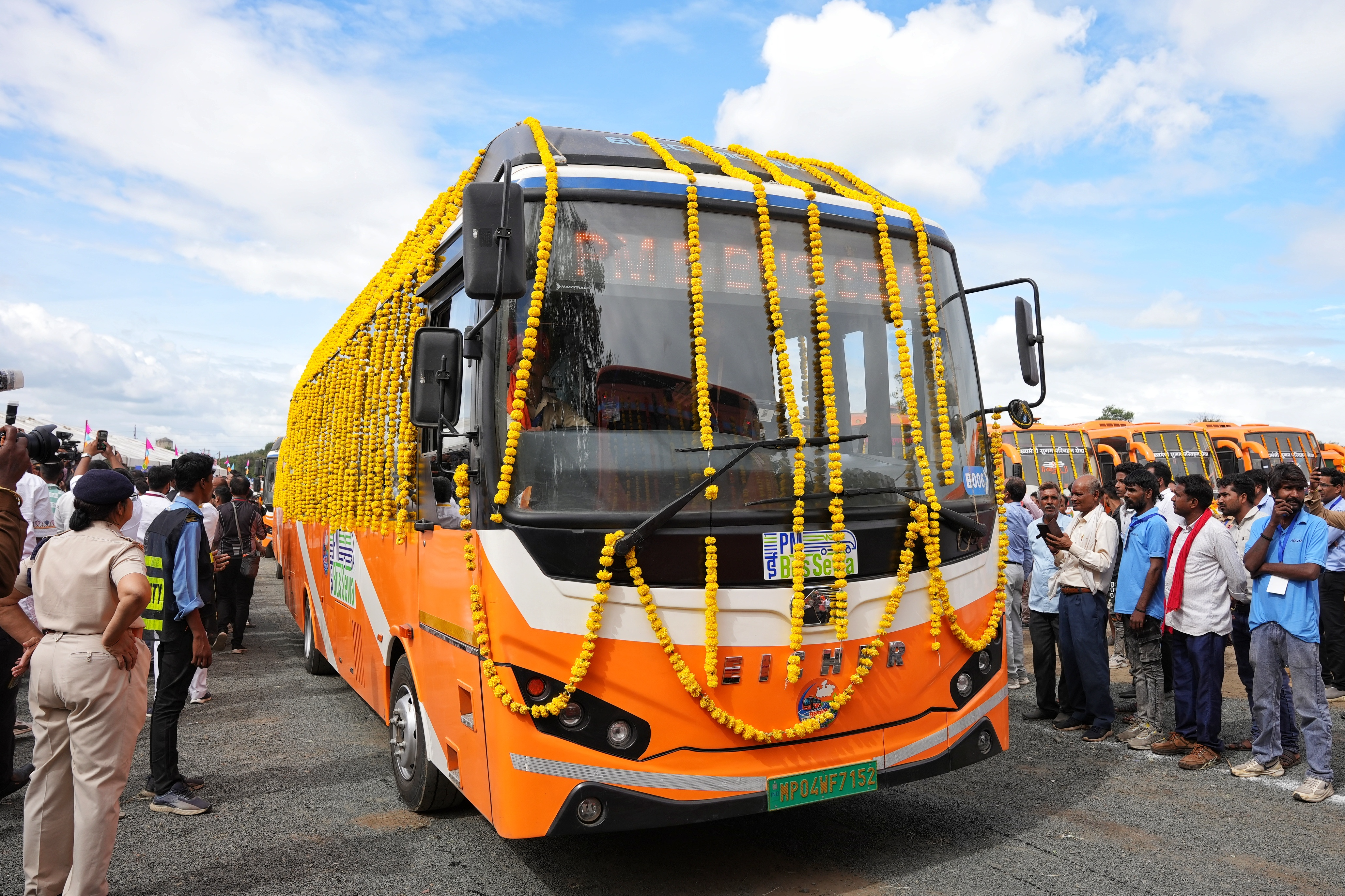 Buses flagged off by MP CM Dr Yadav and Minister Gadkari
351 buses rolled out across seven cities
The first phase covers Indore, Bhopal, Jabalpur, Rewa, Dewas, Katni and Bhind. Of the 351 buses launched, 120 are intercity buses and 231 are intracity buses.
Indore has received the largest deployment with 145 buses, comprising 50 intercity and 95 intracity services. Bhopal will have 106 buses, including 23 intercity and 83 intracity buses, while Jabalpur will operate 67 buses, comprising 14 intercity and 53 intracity services.
Rewa has been allocated 18 intercity buses, followed by 10 in Dewas, three in Katni and two in Bhind.
The Madhya Pradesh Passenger Transport Company (MPYPIL) also signed an MoU with IIM Indore and the School of Planning and Architecture (SPA), Bhopal. A short film on the two transport initiatives was screened and a booklet was released during the event.
After the programme, Chief Minister Dr Yadav travelled on one of the buses after purchasing a ticket, accompanied by other public representatives.
‘This is just the news reel’
Addressing the gathering, Gadkari described the launch of electric buses in Madhya Pradesh as a significant beginning, saying, “This is just the news reel; the real film is yet to begin.”
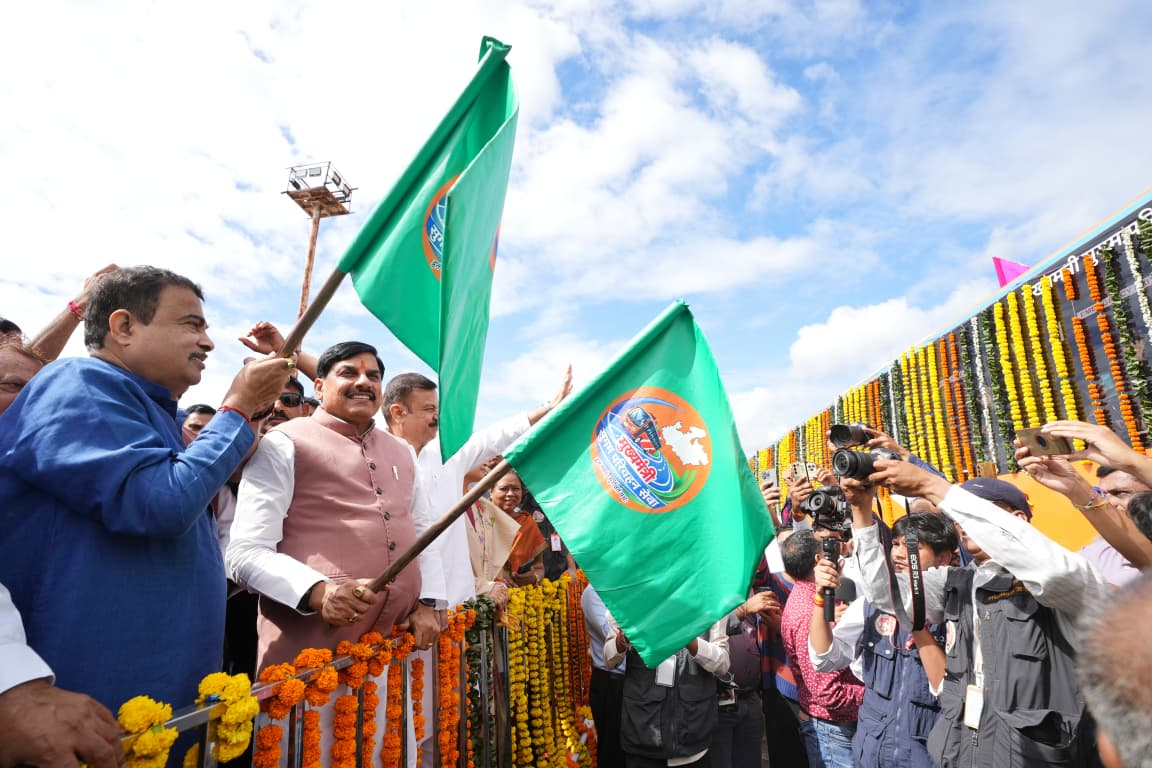 Both the leaders present at the launch event
He said he wanted to develop a model under which Madhya Pradesh could acquire as many as 25,000 buses without placing a financial burden on the government, while generating revenue through taxation.
Gadkari said electric mobility could reduce fuel imports and pollution while creating opportunities for farmers through ethanol production. He noted that the country currently imports petrol, diesel and gas worth around ₹22 lakh crore and said a shift towards electric and alternative-fuel vehicles could help reduce this dependence.
Under the PM E-Bus Seva scheme, 10,000 buses are planned nationally at a cost of ₹57,000 crore, with the Centre providing ₹20,000 crore in support. Madhya Pradesh has been allocated 972 PM E-buses, although Gadkari said the state needed around 25,000 electric air-conditioned buses.
He also highlighted the need for more vehicle scrapping centres and driver-training facilities in the state.
21-year gap ends in state bus services
CM Dr Yadav said public bus services were being restarted in Madhya Pradesh after a gap of 21 years. He said the service would gradually extend to every city and district, including remote tribal areas.
The Chief Minister said the buses would be equipped with CCTV cameras, panic buttons, emergency doors, GPS monitoring, online ticketing and complaint-resolution mechanisms. A survey of more than 3,000 routes across all 55 districts has been conducted, with the government aiming to expand services significantly by 2029.
The state has set a target of operating 15,000 buses by 2031, including 1,500 buses in the first year. Around 2,500 to 3,000 buses are expected to be added annually thereafter.
Real-time monitoring and greater private participation
Bus operations, locations and schedules will be monitored through an Intelligent Transport Management System (ITMS). Command-and-control centres have been established through the Madhya Pradesh Passenger Transport and Infrastructure Limited and its seven subsidiary companies for real-time monitoring.
Safety provisions will particularly focus on women and children, with CCTV cameras, panic buttons and vehicle-location tracking devices. Passenger Information Systems will provide travellers with details about bus operations and journeys.
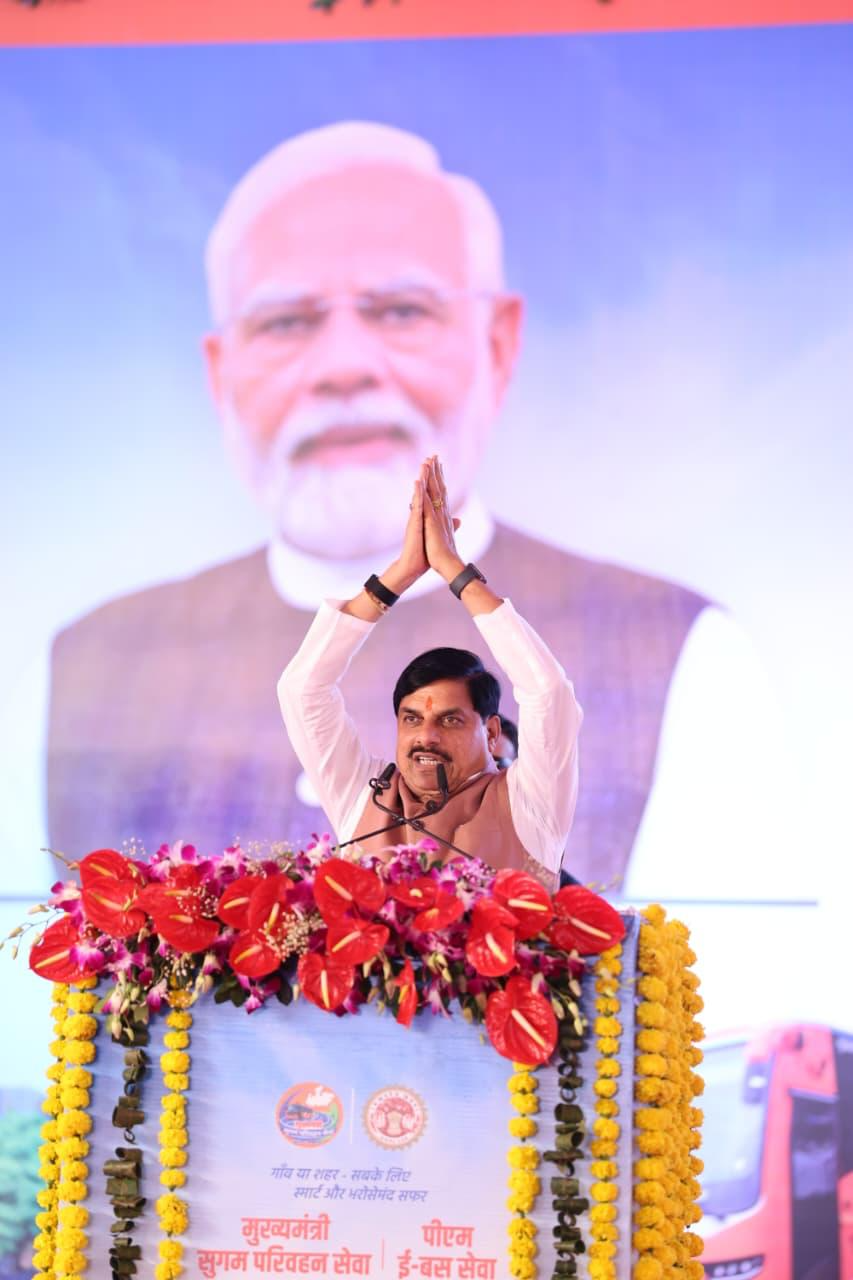 MP CM Dr Yadav addressing the event
The service will also encourage private bus operators to participate through the Public-Private Partnership (PPP) model, alongside transparent contracts and incentive schemes.
The government said the expansion of electric and CNG buses would promote cleaner mobility while improving access to education, employment, healthcare and other essential services. The wider transport network is also expected to create opportunities in bus operations, electric mobility, charging infrastructure, vehicle manufacturing and related sectors.