 Shubh Laabh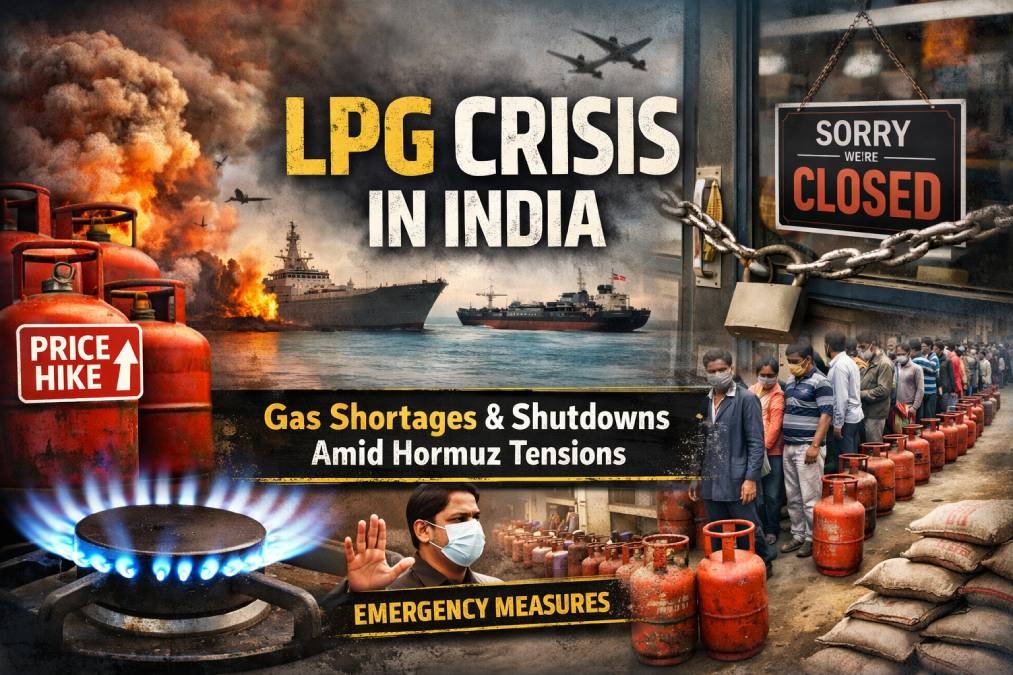
LPG Crisis
LPG Gas Supply Crisis India: The US-Israel war with Iran has disrupted gas supplies through the Strait of Hormuz. This is causing a shortage of LPG in the country. Several states, including Delhi, Madhya Pradesh, Maharashtra, Uttar Pradesh, and Rajasthan, have banned commercial gas supplies in their states. The gas supply disruption has forced restaurants and hotels to close in many cities. Government sources say that oil companies will discuss the situation with restaurant associations through a three-member committee to understand the difficulties with LPG supply. The government increased the price of domestic gas cylinders by Rs 60. The price of the commercial cylinder is also increased by Rs 115 on March 1.
The Essential Commodities Act, 1955 has been implemented across the country meanwhile, across the country to prevent hoarding of essential commodities, including gas. Gas will now be divided into four
Categories :
Category 1 :
This includes full supply of household cooking gas (PNG) and CNG for vehicles. These will continue to receive the full supply as before.
Category 2 :
Fertilizer factories will receive approximately 70% of the gas. They must prove their eligibility that the gas sullpied is strictly being used for the production of fertilizers only.
Third Category :
Large factories connected to the national grid and Tea factories will get about 80% of the gas they require so that the production is not disrupted.
Fourth Category :
Small factories, hotels and restaurants connected to the city gas network will also be provided with approximately 80% depending on their past consumption record.
What is the Essential Commodities Act?
The Essential Commodities Act of 1955 is a law that empowers the government to regulate the supply and prices of essential commodities such as grains, pulses, edible oils, medicines, or fuel. Simply put, it’s an “anti-hoarding law”. Whenever there’s a shortage of Goods or its price rises too much, the government enforces this law. Under this law, traders are allowed to stock a limit, preventing them from storing more than a certain amount of goods in warehouses.
The biggest impact on supply of gas is seen in these states –
Uttar Pradesh –
No delivery even after 4-5 days of booking. The unannounced ban on the supply of commercial cylinders has exacerbated the difficulties in hotels and restaurants. Gas Companies have instructed agencies to focus solely on domestic gas, but despite this, panic persists among the public. In areas like Lucknow, Kanpur and Varanasi, the delivery of gas cylinders is hampered from last 4-5 days.
Maharashtra –
Around 20% of restaurants and restaurants in Mumbai are closed. Commercial gas has been severely cut in Mumbai, Pune, and Nagpur. In Pune, the situation is so dire that the municipal corporation has temporarily closed gas crematoriums. Nearly 9,000 restaurants and bars across the state are facing the threat of closure. Nearly 20% of hotels and restaurants in Mumbai have closed due to a shortage of commercial gas supplies. The hotel association AHAR has warned that if the supply doesn’t improve, more than half, or 50%, of hotels could close within the next two days.
Madhya Pradesh –
Cylinder not available even after price hike. Hotel operators say that despite the price increase, cylinders are still unavailable. They are concerned that Why was the decision made to halt cylinder supply during the wedding season? Bhopal has over 2,000 medium-sized and large hotels and restaurants that use commercial cylinders. Around 1000 marriages are on the pipeline this month and caterers are worried that if supply of gas cylinder will not be there how they will manage.
Rajasthan –
People associated with hotels, restaurants and marriage gardens are facing problems. Hotel and restaurant owners here say they have no alternative to gas. Consequently, those involved in all types of hotels, restaurants, wedding gardens, and other industries are bound to face significant difficulties. The oil companies’ sudden decision is disturbing.
Karnataka –
Hotels are also an’essential service’, but their closures are causing problems for the elderly and students. The Bengaluru Hotel Association says hotels will have to close if supplies aren’t restored. According to the association, the hotel industry falls under the category of ” essential services”. Senior citizens, students, and patients rely on hotels for food. This will cause significant hardship to the general public.
The government has taken five important steps to deal with the crisis –
1. High-level committee formed : In view of the crisis, the Petroleum Ministry has formed a high-level committee of executive directors of three oil companies, which will review the supply.
2. Essential Commodity Act implemented : To control the supply of gas, the central government implemented the Essential Commodity Act across the country.
3. LPG bookings will be open after 25 days : The rules for booking domestic cylinders have been changed. Consumers can book their second cylinder only after 25 days of delivery.
4. OTP and Biometric Mandatory: To prevent gas hoarding, delivery agents are strictly using OTP or biometric verification.
5. Order to increase LPG production: The government ordered all oil refineries to increase LPG production. Sources say production has now increased by 10%.
Main reasons for supply crisis –
1. Near-closure of the Strait of Hormuz – The biggest challenge for India is the closure of the Strait of Hormuz. This 167-kilometer-long waterway connects the Persian Gulf to the Arabian Sea. Due to the Iran war, this route is no longer safe. Due to the danger, no oil tankers are passing through it. 20% of the world’s petroleum passes through it. Countries like Saudi Arabia, Iraq, and Kuwait also import petroleum
products for their exports. India imports 50% of its crude oil and 54% of its LNG needs through this route. Iran itself exports through this route.
2. LNG production halted due to drone attack on the plant – Last week, the US and Israel carried out strikes on Iran. In response, Iran targeted US bases in countries like the UAE, Qatar, Kuwait, and Saudi Arabia. Following the Iranian drone attack, Qatar, India’s largest gas supplier, has halted production at its LNG plant. This has reduced India’s gas supply. India imports 40% of its LNG needs (approximately 27
million tons annually) from Qatar.
When will the situation likely to improve –
According to Indian Oil, said customers need not panic or resort to panic booking. The government is now considering sourcing alternative cargoes from countries like the United States. Meanwhile, internationally, the G7 countries are discussing releasing supplies from their emergency oil reserves to alleviate the energy crisis in the global market. Additional crude oil is also expected to arrive from Russia and Algeria.
Read More:- Rupee Tumbling Down against Dollar