
 Rohan Umak
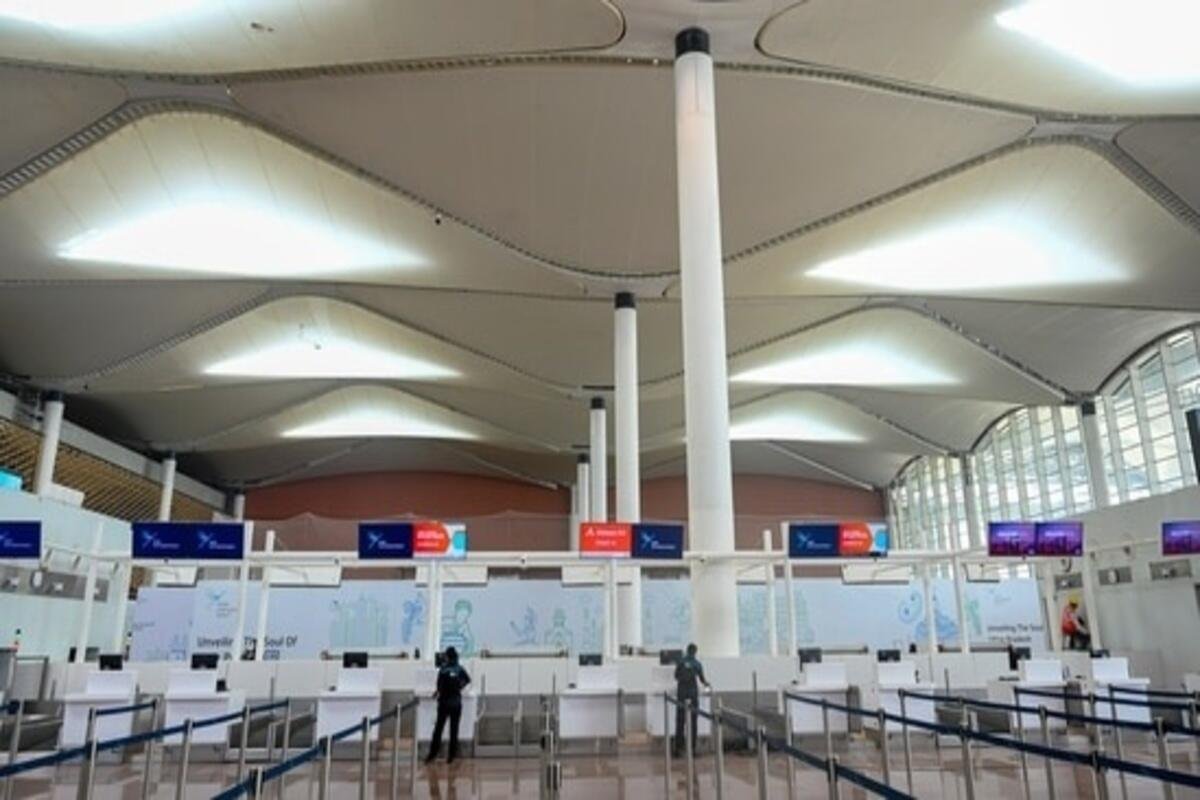
Jewar International Airport: Prime Minister (PM) Narendra Modi on Saturday inaugurated the Phase I of the much-anticipated Noida International Airport at Jewar, marking a stride in India’s ambition to emerge as a powerhouse for global aviation. PM Modi took stock of the state-of-the-art terminal building before addressing a huge public gathering, and hailed the project as transformative for regional connectivity.

Airport developed at an outlay of Rs 11,200 cr
Officials said that the airport has been developed at a cost of around Rs 11,200 crore under a Public-Private-Partnership (PPP) model, and is among one of the country’s largest greenfield aviation projects. They added that the airport is expected to serve as a major international gateway for the National Capital Region (NCR), ramping up India’s airport infrastructure.
Jewar International Airport: Delhi’s Air Traffic expected to ease
The airport has been designed to complement Delhi’s Indira Gandhi International Airport, and will operate as part of an integrated aviation system. Officials believe it will subsequently reduce congestion in Delhi’s airspace, will enhance passenger handling capacity and will position NCR among the world’s leading aviation hubs.
The Jewar airport, in its initial phase, will handle 1.2 crore passengers annually, with scalability to accommodate as many as 7 crore travellers upon full expansion. Towards the end of the project, it is expected to reach a staggering capacity of 225 million passengers per year.
Airport laced with advanced technology for all-weather operations
The airport, according to the officials, boasts a 3900-metre runway capable of accommodating wide-body aircrafts such as the Boeing 777-300ER. It is laced with advanced navigation systems, including the Instrument Landing System (ILS), ensuring precise guidance for aircraft even in low visibility.
It has also been granted an aerodrome license recently by the Directorate General of Civil Aviation (DGCA), and has received the nod for all-weather operations. The ILS, installed at both ends of the runway, facilitates the aircraft to land safely during fog or haze, the type of conditions that often result in disruption of flights.
Facility spread across 11,742.45 acres
The facility spans across 11,742.45 acres and will feature an 87-acre multi-modal cargo hub as well as a dedicated maintenance, repair and overhaul (MRO) facility, which will be the first of its kind within an Indian Airport. Additional infrastructure on the cards includes logistics zones and courier terminals to support growing trade demands.
It is also noteworthy that the project incorporates eco-friendly design elements, such as natural lighting, rainwater harvesting and renewable energy integration, aligning with India’s net-zero ambitions.


 Shubh Laabh