
 Shubh Laabh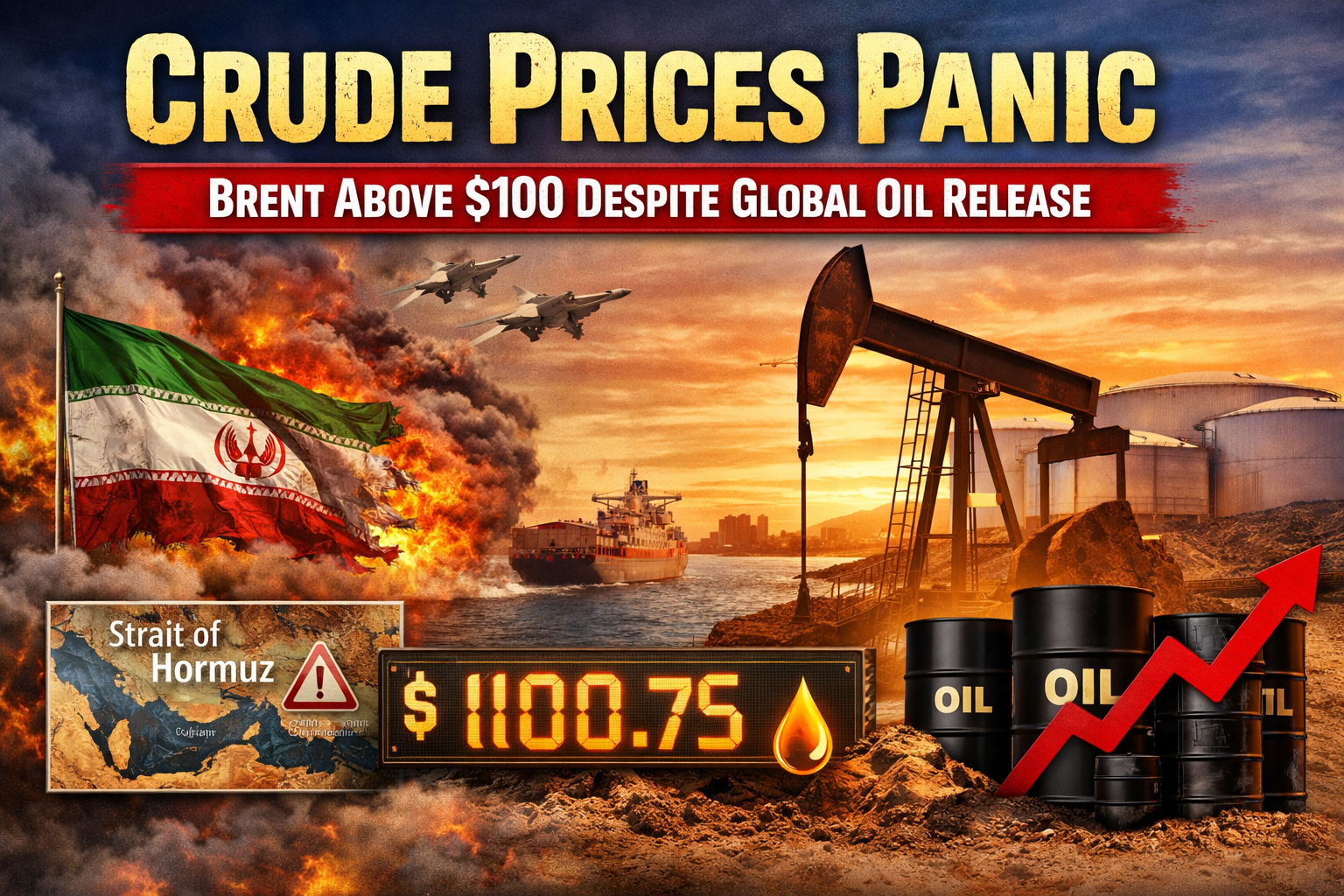
Crude Prices Panic: 30 countries have opened their Oil stocks, yet why are the prices are still rising. A total of 400 million barrels of oil released into the market plan has been to put in place the supply and to control prices. Despite this, crude prices continue to rise, with Brent remaining above $100. But such a significant move is also failing to stop the market.
Crude Prices Panic: Iran War Triggers Massive Oil Supply Shock
The global oil market has been hit hard following the Iran war. To manage the situation, more than 30 countries, including the United States, have decided to release the largest emergency Oil stockpile in history. A total of 400 million barrels of oil is planned to be released into the market to control prices. Despite this, crude oil prices continue to rise, and Brent remains above $100.
Crude Prices Panic: Strait of Hormuz Tensions Disrupt Global Oil Movement
Global oil supply affected due to Iran war. The situation has had a significant impact. In particular, the escalating tensions in the Strait of Hormuz have disrupted Oil movement, one of the world’s most important oil transit routes. This is why the US and its allies decided to release their emergency oil reserves to ease market panic.
30+ Countries Announce Historic 400 Million Barrel Release
More than 30 countries in Europe, North America, and Asia have collectively decided to release 400 million barrels of crude oil into the market. This is the largest emergency oil release in the history of the International Energy Agency (IEA).
US Leads With Strategic Petroleum Reserve Supply Plan
America is leading this entire initiative. The US will release 172 million barrels of oil from its Strategic Petroleum Reserve (SPR). This represents approximately 43% of the total release. However, this oil will not be released to the market all at once but will be released gradually over approximately 120 days.
The oil market fears that the real problem is the closure of the Strait of Hormuz has significantly impacted oil supplies. The announcement did not reassure the market, and crude prices continued to rise. Brent crude closed above $100 per barrel for the second consecutive day.
Hormuz Route Disruption Hits Major Oil Exporters
This is the route through which much of the world’s oil is transported by major oil exporters like Saudi Arabia, Iraq, Kuwait, and the United Arab Emirates. Before the war, these countries together exported approximately 14 million barrels of oil per day.However, only 5 to 6 million barrels per day can be diverted through the pipeline. This means that approximately 9 million barrels per day of oil, or about 10% of global supply, is still disrupted.
At first glance, this is a very large quantity. It seems likely. But in reality, that much oil won’t come to market immediately. The US alone will release only about 1.4 million barrels per day over 120 days. This represents only 15% of the supply affected by the Strait of Hormuz. This is why experts told that this move will certainly ease the crisis, but will not solve the entire problem.
Experts Warn Oil Prices Could Climb Further
Many energy market analysts estimated that if the war continues for a long time, oil prices could rise further. If the conflict lasts two months, Brent crude could reach $110 per barrel. If the war drags on for four months, prices could reach $135 per barrel. Because the Strait of Hormuz is not only used for oil but also for approximately 20% of the world’s LNG exports. LNG is a vital fuel for power generation and heating. Therefore, this crisis could impact not only the oil market but the entire energy market.
Oil Prices Likely to Stay Volatile Until Route Reopens
Despite the largest oil stock release in history, market concerns have not subsided. The real problem will remain until the Strait of Hormuz fully reopens. Therefore, oil prices may continue to fluctuate and rise for the time being.
Read More-Israel PM Netanyahu dismisses death rumours, posts video while sipping coffee



 Rohan Umak